
Microsoft Fabric already provides a unified data platform through services like OneLake, Lakehouse, Warehouse, Eventhouse, and Power BI. These components help organizations ingest, store, process, and analyse data from different sources in one place.
However, even with a unified platform, many organizations still face a common challenge.
Different teams often define the same business concept in different ways.
For example:
| Team | Definition of Revenue |
| Finance | Recognized Revenue |
| Sales | Sales Amount |
| Analytics | Total Transaction Value |
Even though these definitions may refer to the same business concept, they are often calculated differently or stored in different systems. This leads to confusion, inconsistent reports, and difficulties when building AI solutions.
To address this challenge, Microsoft introduced Fabric IQ (Preview).
Fabric IQ helps organizations define business concepts once and use them consistently across the entire data platform.
What is Fabric IQ ?
Fabric IQ is the intelligence layer of Microsoft Fabric that helps AI understand your organization’s business data by combining information from OneLake, Semantic Models, and Ontologies.
Rather than relying only on table and column names, Fabric IQ provides business context that enables AI to understand business entities, relationships, and definitions. This allows AI experiences across Microsoft Fabric to deliver more accurate, relevant, and consistent insights.
With Fabric IQ, tools such as:
- Power BI Copilot
- Data Agents
- Notebooks
- Custom AI applications
can interpret data using a shared business language, improving natural language analytics and AI-powered decision making.
Instead of interacting directly with raw tables, AI experiences use the business knowledge defined through Semantic Models and Ontologies, enabling consistent answers across the Fabric platform.
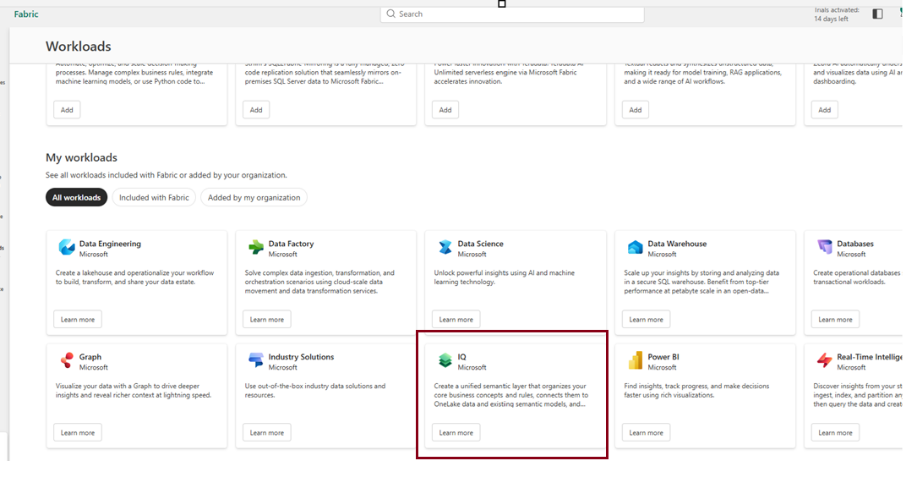
For example, instead of querying a technical table like:
Fabric IQ understands business meaning, so tools can work with concepts such as:
This creates a consistent, business-friendly, and easy-to-understand representation of enterprise data across the organization.
This creates a consistent and understandable representation of business data across the organization.
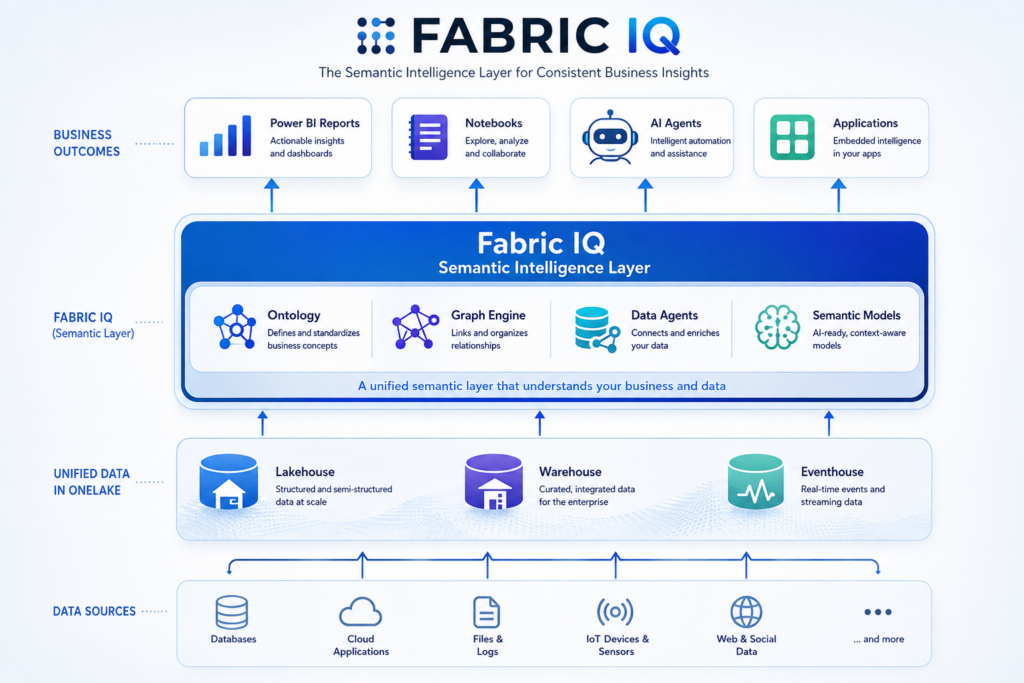
Understanding Fabric IQ from the Diagram
The diagram explains how Fabric IQ acts as the intelligence layer between data and analytics tools.
Data Layer – Where Data Lives
At the bottom of the diagram we see data sources inside OneLake:
- Lakehouse – stores structured and unstructured data
- Warehouse – optimized for SQL analytics
- Eventhouse – handles real-time streaming data
These are the places where enterprise data is stored in Microsoft Fabric.
Fabric IQ – The Semantic Intelligence Layer
In the middle of the diagram is Fabric IQ.
Fabric IQ adds business meaning to the data using several components:
- Ontology – defines business concepts like Customer, Order, Product
- Graph Engine – connects relationships between these concepts
- Data Agents – AI assistants that answer business questions
- Operations Agents – monitor data and trigger actions
This layer converts raw data into business understanding.
Intelligence & Analytics Layer – How Users Consume Data
At the top of the diagram are the tools that use the data:
- Power BI Reports – dashboards and analytics
- Notebooks – data science and engineering analysis
- AI Agents – conversational data insights
- Applications – business apps that use enterprise data
Because of Fabric IQ, all these tools interpret the data using the same business definitions.
Simple Way to Understand the Diagram
Lakehouse • Warehouse • Eventhouse
Business Meaning Layer
Think of Fabric IQ like a translator between your data and your users.
It understands the technical data stored in Microsoft Fabric and presents it in business-friendly terms, making it easier for people, AI, and applications to discover, understand, and use the data.
So instead of tools reading raw tables directly, they understand the business context behind the data.
Key Takeaway
Fabric IQ ensures that:
- data is unified across OneLake
- business concepts are defined once
- analytics and AI use consistent definitions
This is why Fabric IQ is called the Semantic Intelligence Layer of Microsoft Fabric.
Why Do We Need Fabric IQ?
Fabric IQ introduces several capabilities that help organizations manage and understand their data more effectively.
Data Unification
Fabric IQ can combine data from multiple Fabric sources such as:
- Lakehouse tables
- Eventhouse streaming data
- Power BI semantic models
This data is organized into a single logical model of the business.
Instead of navigating multiple datasets or pipelines, users can interact with a unified representation of enterprise data.
Consistent Business Language
Fabric IQ allows organizations to define key business concepts like:
- Customer
- Product
- Shipment
- Asset
once within an ontology.
Once defined, these concepts are reused across tools and workloads.
| From | Relationship | To |
|---|---|---|
| Customer | places | Order |
| Order | shipped via | Route |
This creates a shared vocabulary for the entire data platform, ensuring that all analytics and AI solutions interpret data consistently.
Faster Analytics Development
When business concepts are already defined in a central model:
- Dashboards can reuse existing definitions
- AI applications can understand the same terminology
- Developers do not need to recreate business logic repeatedly
This significantly reduces the time required to develop new analytics solutions.
Governance and Data Quality
Fabric IQ also improves data governance and trust.
Organizations can enforce rules such as:
- business constraints
- standardized definitions
- validation rules
For example:
Customer ID must be unique.
These constraints ensure that business data remains consistent and reliable across teams.
AI-Ready Data Platform
One of the most important goals of Fabric IQ is to prepare enterprise data for AI and Copilot experiences.
AI systems can use the semantic definitions in Fabric IQ to understand business concepts rather than relying on raw database structures.
For example, an AI agent might ask:
Which shipments were affected by temperature breaches?
Fabric IQ can trace relationships such as:
Shipment → Route → Sensor → Temperature Event
This ability to connect related concepts across systems enables cross-domain reasoning, which is critical for modern AI-driven analytics.
Key Components of Fabric IQ
Fabric IQ consists of several items that work together to create a unified semantic layer.
These include:
- Ontology (Preview) – Defines business entities, relationships, properties, and rules.
- Graph (Preview) – Represents and analyzes relationships between business concepts.
- Data Agent (Preview) – Enables conversational AI experiences for querying data.
- Operations Agent (Preview) – Monitors real-time data and recommends operational actions.
- Power BI Semantic Models – Provide trusted KPIs, measures, and analytical relationships.
Fabric IQ can even generate ontologies directly from existing Power BI semantic models, ensuring that the same business definitions are reused across reports, analytics tools, and AI applications.
Fabric IQ vs Power BI Semantic Model
Many people assume that Fabric IQ replaces Power BI semantic models, but they actually serve different purposes.
| Feature | Fabric IQ | Power BI Semantic Model |
| Purpose | Enterprise semantic layer | BI reporting layer |
| Focus | Business concepts | Measures and KPIs |
| Used by | AI agents, applications, analytics | Power BI reports |
| Structure | Ontology and graph model | Dimensional model |
| Scope | Cross-domain enterprise model | Dataset for reporting |
In simple terms:
Power BI semantic model = Reporting layer
Fabric IQ = Enterprise semantic intelligence layer
Both work together within Microsoft Fabric.
What Comes Next?
In this lesson, we introduced Fabric IQ and its purpose as the semantic intelligence layer of Microsoft Fabric.
However, Fabric IQ includes several architectural components such as:
- Ontology
- Graph engine
- Data agents
- Operations agents
Understanding how these components interact requires a deeper look at the Fabric IQ architecture.
In the next lesson, we will explore the architecture of Fabric IQ.
Conclusion
Fabric IQ introduces a new concept in Microsoft Fabric: semantic intelligence.
Instead of only storing and analyzing data, Fabric IQ helps organizations:
- define business concepts
- connect data relationships
- enable AI-driven reasoning
- automate operational decisions
By combining ontology, graph analysis, semantic models, and AI agents, Fabric IQ transforms Fabric into a semantic-aware intelligence platform.
As Microsoft continues to evolve Fabric, Fabric IQ will play a key role in enabling AI-ready enterprise data ecosystems.
| Tags | Microsoft Fabric |
| Useful Links | |
| MS Learn Modules | |
Test Your Knowledge |
Quiz |