
Understanding the Fabric IQ Architecture
Modern organizations generate large volumes of data from business applications, connected devices, customer transactions, and digital interactions. While data availability has increased significantly, a common challenge remains, different teams often interpret the same business terms in different ways.
For example, a sales team may consider revenue at the time a contract is signed, while a finance team may recognize revenue only after payment is received. Such differences create confusion in reporting and reduce confidence in analytics outcomes. This challenge is commonly known as semantic drift, where the same business term carries different meanings across systems.
Architecture Overview
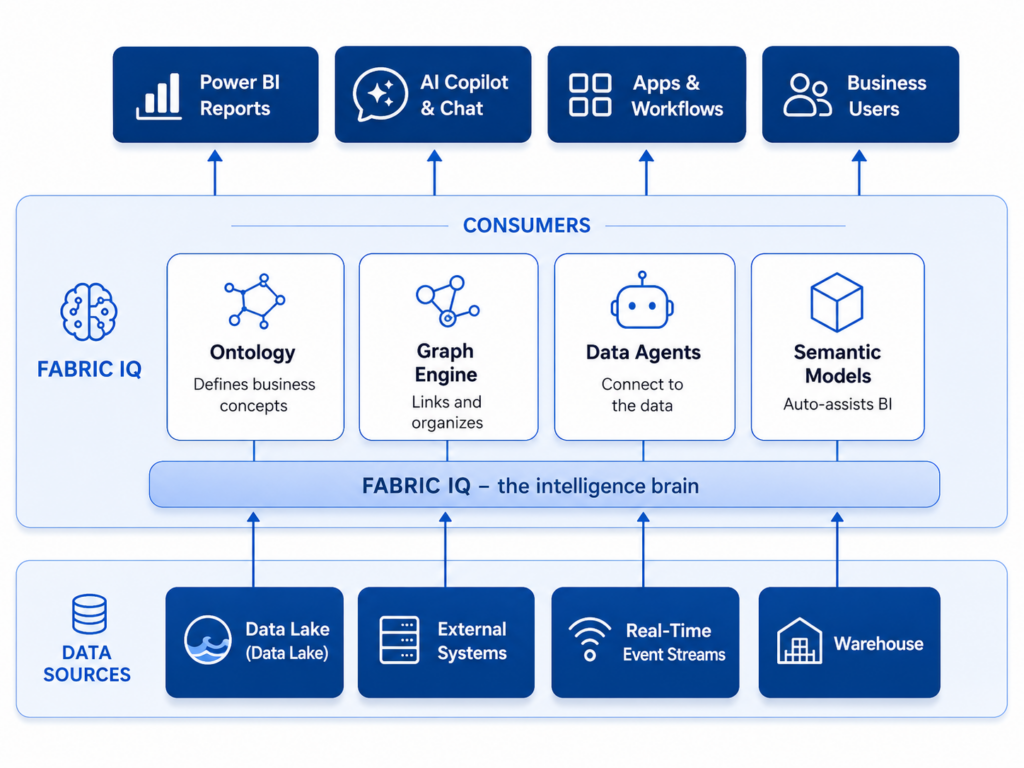
Fabric IQ follows a layered architecture that connects raw data sources with intelligent insights and automated actions.
At a high level, the architecture includes:
- A unified data foundation for storing enterprise data
- A semantic intelligence layer that defines business meaning
- AI-driven consumers such as analytics tools and intelligent agents
These layers work together to create a complete data intelligence pipeline transforming raw data into meaningful insights and operational decisions.
Key architectural components include:
- OneLake – centralized storage shared across Fabric workloads
- Ontology – business knowledge model defining entities and relationships
- Knowledge Graph – connected structure enabling relationship analysis
- Data Agents – AI assistants that answer business questions
- Operations Agents – intelligent systems that monitor data and trigger actions
- Power BI Semantic Models – curated analytics layers supporting reporting and ontology creation
1. Data Foundation – OneLake
A reliable data foundation is essential for any analytics platform. In Microsoft Fabric, this role is fulfilled by OneLake, which acts as a unified storage layer for organizational data.
Data stored in OneLake can originate from multiple sources such as lakehouses, data warehouses, streaming platforms, and existing analytics models. Because all workloads access the same shared data foundation, organizations can avoid unnecessary duplication and maintain consistent governance practices.
Fabric IQ leverages this unified storage by directly connecting business definitions to live enterprise data, ensuring that insights remain accurate and up to date.
2. Ontology – The Business Knowledge Layer
The ontology represents the core intelligence component of Fabric IQ. While traditional database schemas describe how data is structured, an ontology focuses on what the data represents from a business perspective.
It defines:
- Business entities such as Customer, Order, Product, or Shipment
- Attributes associated with each entity
- Relationships connecting different business concepts
- Rules governing operational processes
By defining these elements in a structured way, organizations create a shared understanding of business terminology. Once definitions are established, analytics reports, dashboards, and AI systems use the same logic consistently, reducing ambiguity across departments.
Fabric IQ also enables organizations to generate an initial ontology from existing Power BI semantic models. This approach helps preserve prior investments in business logic while extending their value into AI-driven experiences.
3. Knowledge Graph – Connecting Relationships
After business concepts are defined in the ontology, Fabric IQ organizes them into a knowledge graph. In this model, business entities are represented as nodes and their relationships as connections.
This structure allows analysts and AI agents to explore how different parts of the business interact. For instance, a shipment delay may influence customer satisfaction, service-level agreements, and revenue recognition timelines.
By enabling multi-step relationship analysis, the knowledge graph supports deeper insights that would otherwise require complex data integration efforts.
4. Data Agents
Fabric IQ introduces data agents that enable users to interact with enterprise data using natural language. These agents rely on shared business definitions from the ontology, ensuring that responses are aligned with organizational terminology and logic.
Users can ask questions such as:
- Which product category generated the highest revenue this quarter?
- What factors contributed to declining sales in a specific region?
- Which customers are approaching contract renewal dates?
Because data agents are grounded in business context, they provide more consistent and explainable insights compared to traditional query-based approaches.
5. Operations Agents
Operations agents extend analytics capabilities by continuously monitoring real-time data and identifying important changes or risks. They can recommend corrective actions, notify relevant teams, or support automated responses for routine scenarios.
For example, an operations agent might detect declining inventory levels and alert supply chain managers before stock shortages impact customer deliveries. Over time, organizations can configure varying levels of automation based on operational confidence and governance requirements.
This proactive approach helps organizations move from reactive reporting towards intelligence-driven operations.
6. Power BI Semantic Models
Power BI semantic models continue to play an important role in the Fabric ecosystem by providing curated metrics, hierarchies, and relationships optimized for reporting and analysis.
Fabric IQ can extend these models by transforming existing definitions into ontology elements, ensuring consistency between traditional dashboards and AI-driven decision tools.
This integration allows organizations to leverage existing analytics investments while gradually adopting advanced intelligence capabilities.
How the Components Work Together
When combined, Fabric IQ components create a unified data intelligence workflow:
- Enterprise data is stored in OneLake.
- Business concepts and rules are defined in the ontology.
- Relationships between entities are organized in a knowledge graph.
- Data agents provide conversational insights based on business context.
- Operations agents monitor events and recommend or trigger actions.
This integrated architecture enables organizations to transform raw data into actionable intelligence more efficiently.
Conclusion
Fabric IQ represents an evolution in enterprise data architecture by introducing a shared semantic layer that connects data storage, analytics, and AI capabilities.
By establishing consistent business definitions, mapping relationships, and enabling intelligent automation, organizations can improve trust in analytics outcomes and respond more effectively to operational changes.
In essence, Fabric IQ helps organizations move beyond managing data toward understanding and acting on it with greater confidence.
| Tags | Microsoft Fabric |
| Useful Links | |
| MS Learn Modules | |
Test Your Knowledge |
Quiz |