
If you’re starting your journey into modern data platforms, you’ve probably come across three popular names: Microsoft Fabric, Azure Databricks, and Snowflake. At first, they may seem similar because all three help organizations store, process, and analyse data. However, each platform is built with a different approach and offers its own unique strengths.
In this lesson, we’ll explore what each platform is, how their architectures differ, where each one performs best, and how to choose the right platform based on your needs.
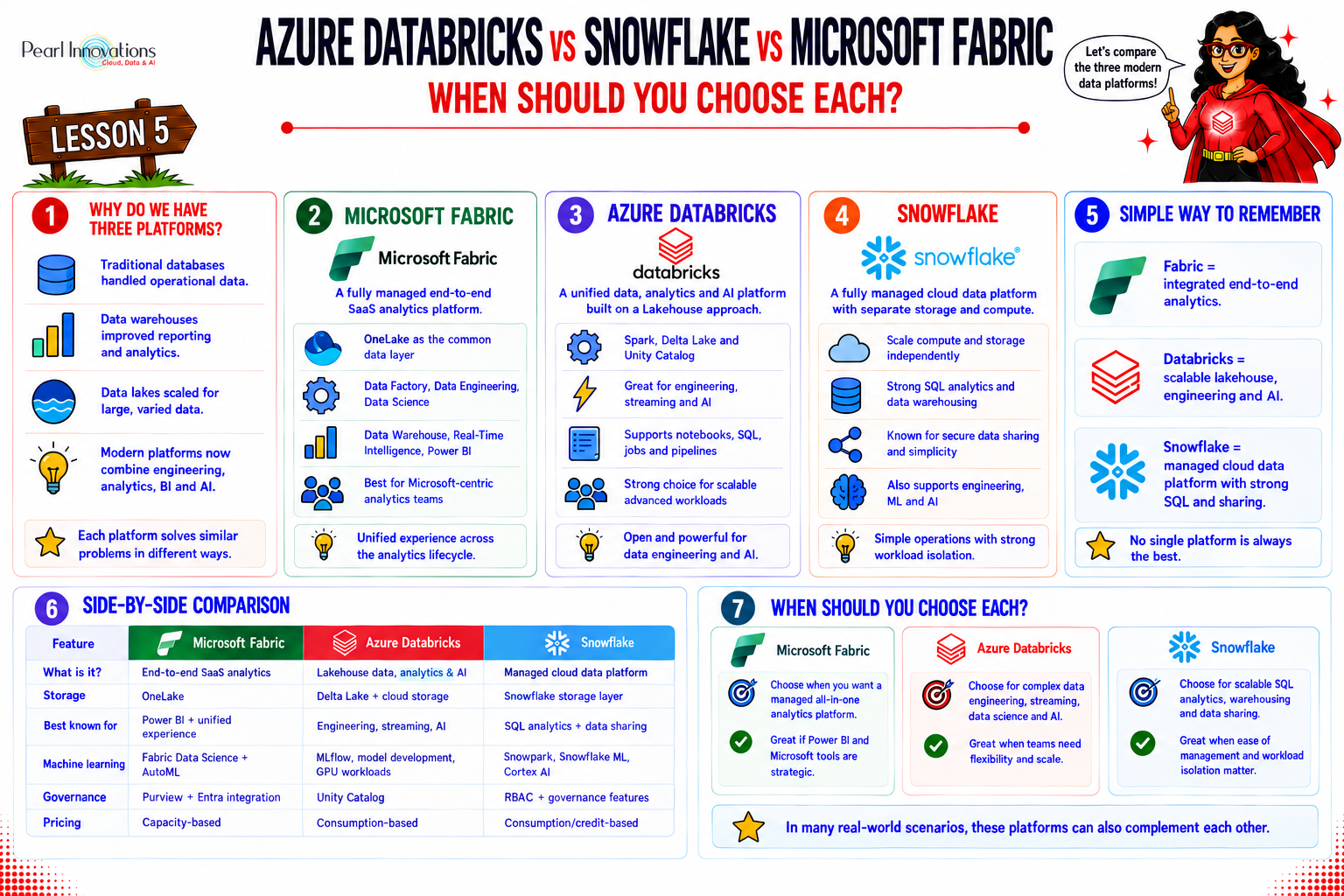
🚀 Learn It in 5 Minutes
Skip the long read.
See the key concepts in one easy-to-follow infographic.
Why Do We Have Three Different Platforms?
Over the years, the way organizations store and work with data has changed significantly. Initially, businesses relied on traditional databases to manage their information. As data volumes grew, data warehouses became the preferred choice for reporting and analytics. Later, data lakes emerged to store large amounts of structured and unstructured data.
Today, these technologies are increasingly coming together through modern data and Lakehouse architectures. A Lakehouse combines the flexibility and scalability of a data lake with many of the performance, reliability, and management capabilities traditionally associated with a data warehouse.
Microsoft Fabric, Azure Databricks, and Snowflake are all modern data platforms designed to help organizations perform common data tasks such as data ingestion, data engineering, analytics, AI and machine learning, and reporting. While they solve many similar business challenges, each platform has a different architecture and areas of strength.
Meet the Three Platforms
Microsoft Fabric
Microsoft Fabric is a fully managed, end-to-end Software as a Service (SaaS) analytics platform from Microsoft. It brings together capabilities such as Data Factory, Data Engineering, Data Science, Data Warehouse, Real-Time Intelligence, and Power BI into a single unified experience.
These workloads work closely with a common logical storage layer called OneLake, allowing teams to work within one integrated environment. This reduces the need to connect and manage multiple separate services for data ingestion, transformation, analysis, and reporting.
Azure Databricks
Azure Databricks is a unified data, analytics, and AI platform built around the Lakehouse architecture. It combines technologies such as Apache Spark and Delta Lake with data engineering, SQL analytics, streaming, machine learning, AI, and centralized governance through Unity Catalog.
Azure Databricks is particularly well suited for large-scale data engineering, real-time and streaming workloads, artificial intelligence, machine learning, and advanced analytics. Databricks is available across Microsoft Azure, AWS, and Google Cloud, while Azure Databricks refers specifically to the Databricks service running on Microsoft Azure.
Snowflake
Snowflake is a fully managed cloud data platform built around an architecture that separates storage and compute. This allows organizations to scale storage and computing resources independently based on their workload requirements.
Snowflake is well known for SQL analytics, enterprise data warehousing, and secure data sharing, but it also supports data engineering, applications, machine learning, and AI. It supports structured, semi-structured, and unstructured data and is available across AWS, Microsoft Azure, and Google Cloud.
How Their Architecture Differs
One of the easiest ways to understand the difference between Microsoft Fabric, Azure Databricks, and Snowflake is by looking at how each platform is designed behind the scenes. Although they all help organizations work with data, they use different approaches to achieve their goals.

Microsoft Fabric
Microsoft Fabric is a fully managed Software as a Service (SaaS) platform. Its workloads, including Data Engineering, Data Warehouse, Real-Time Intelligence, Data Science, and Power BI, are integrated within the same platform and work with OneLake.
Since these capabilities are available within one environment, organizations can reduce the number of separate services they need to configure and manage. Security, governance, analytics, and storage are integrated across the Fabric platform.
Azure Databricks
Azure Databricks follows the Lakehouse architecture. It uses technologies such as Apache Spark for distributed data processing and Delta Lake to provide reliable data storage with capabilities such as ACID transactions.
Teams can work using notebooks, SQL, pipelines, jobs, and development tools, making Azure Databricks a strong platform for data engineering, analytics, machine learning, and AI. It also provides optimized compute technologies such as Photon for high-performance data processing and analytics.
Snowflake
Snowflake separates its architecture into storage, compute, and cloud services.
Data is stored in cloud storage, while compute resources can be provided through independent Virtual Warehouses and other Snowflake compute services. Since storage and compute are separated, organizations can scale workloads independently based on their needs.
For example, a team running large reporting workloads can use separate compute from another team performing data engineering or machine learning, helping reduce workload contention.
A simple way to remember these platforms is:
- Microsoft Fabric focuses on an integrated end-to-end analytics experience.
- Azure Databricks focuses on scalable data engineering, analytics, and AI with an open Lakehouse approach.
- Snowflake focuses on a managed cloud data platform with strong SQL analytics, workload scalability, and data sharing.
There is no “best” platform. Each one is designed to solve different business needs.
Side-by-Side Comparison
The table below highlights the key differences between Microsoft Fabric, Azure Databricks, and Snowflake.
| Feature | Microsoft Fabric | Azure Databricks | Snowflake |
| What is it? | An end-to-end SaaS analytics platform combining data integration, engineering, warehousing, real-time intelligence, data science, and Power BI. | A unified data, analytics, and AI platform built around the Lakehouse architecture. | A fully managed cloud data platform that separates storage and compute for independent scaling. |
| Storage | Uses OneLake as the common logical storage layer across Fabric workloads. | Commonly uses cloud object storage with Delta Lake and governance through Unity Catalog. | Uses cloud storage with Snowflake-managed tables and automatic micro-partitioning, while also supporting Apache Iceberg tables. |
| Best Known For | Tight Power BI integration and a unified end-to-end analytics experience. | Large-scale data engineering, streaming, AI, machine learning, and Lakehouse workloads. | SQL analytics, enterprise data warehousing, workload isolation, minimal infrastructure management, and secure data sharing. |
| Machine Learning | Provides Fabric Data Science with notebooks, experiments, MLflow, models, and AutoML. | Provides advanced ML and AI capabilities using technologies such as MLflow, distributed compute, model serving, and GPU workloads. | Provides Snowflake ML, Snowpark, and Cortex AI for machine learning and generative AI workloads. |
| Governance | Integrates capabilities across Fabric, Microsoft Purview, and Microsoft Entra ID for governance and security. | Uses Unity Catalog as the unified governance layer for data and AI. | Provides role-based security, governance, encryption, compliance, and Snowflake Horizon Catalog capabilities. |
| Pricing | Primarily capacity-based, with Fabric compute capacity shared across workloads. | Consumption-based, with costs depending on Databricks compute and the selected compute model. | Consumption-based using credits for compute and services, with storage charged separately. |
| Best Suited For | Organizations wanting an integrated analytics platform, particularly those already using Microsoft Azure and Power BI. | Organizations with large-scale data engineering, streaming, advanced analytics, AI, and machine learning requirements. | Organizations requiring scalable SQL analytics, data warehousing, data sharing, workload isolation, and increasingly AI and ML close to their data. |
Fabric now provides native Data Science capabilities including AutoML and MLflow, while Snowflake’s platform includes Snowflake ML and Cortex AI rather than being limited to Snowpark-based ML.
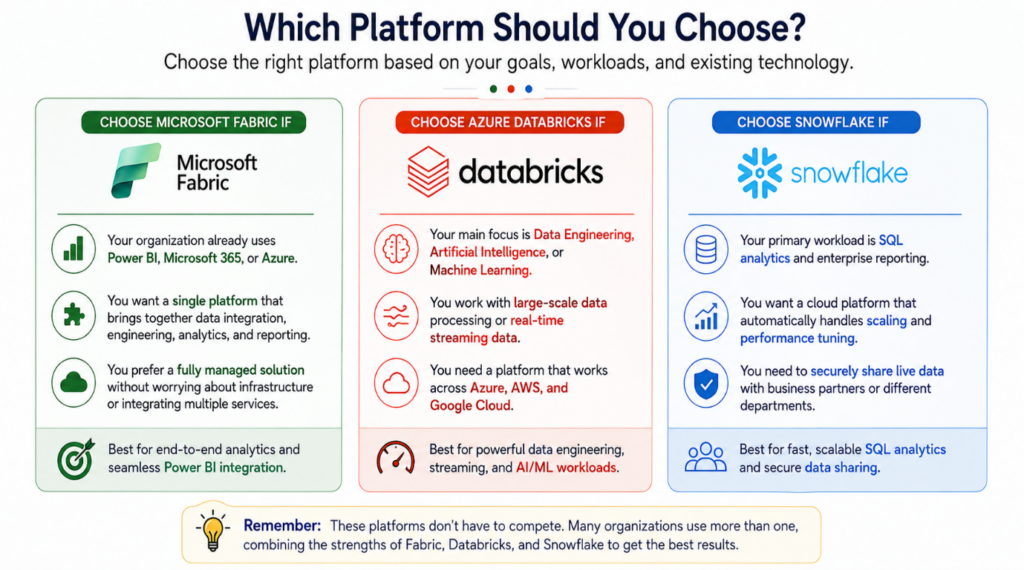
Conclusion
Microsoft Fabric, Azure Databricks, and Snowflake are all powerful modern data platforms, each with different strengths. Microsoft Fabric provides an integrated end-to-end analytics experience, Azure Databricks excels in scalable data engineering and AI-driven Lakehouse workloads, and Snowflake provides a highly managed and scalable platform with strong SQL analytics, data warehousing, data sharing, and growing AI capabilities.
The right choice depends on your organization’s goals, existing technology ecosystem, skills, data architecture, and workload requirements.
In many real-world scenarios, these platforms can also complement each other and be used together to build a modern, scalable data ecosystem.
| Useful Links | |
| Microsoft Learn / Documentation | |
|
Test Your Knowledge |
Quiz |