
In the world of cloud-based data management and analytics, Microsoft offers two leading platforms: Azure Synapse and Microsoft Fabric.
Microsoft Fabric represents Microsoft’s unified analytics vision, while Azure Synapse Analytics continues to be supported for existing enterprise workloads and scenarios requiring greater infrastructure control. Organizations now commonly evaluate Fabric for new analytics initiatives while retaining Synapse for specialized or existing deployments.
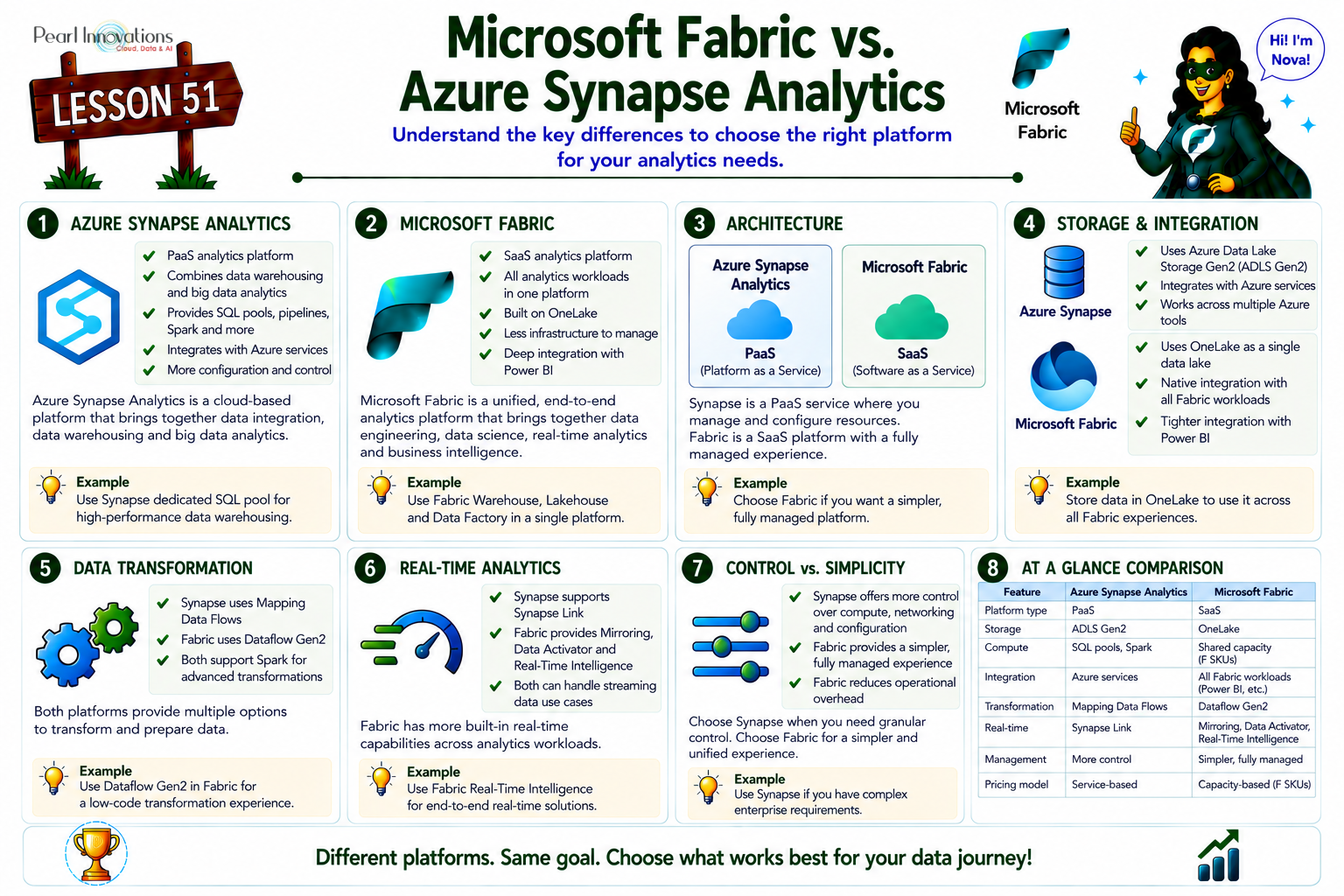
🚀 Learn It in 5 Minutes
Skip the long read.
See the key concepts in one easy-to-follow infographic.
Both platforms are designed to help organizations handle vast amounts of data, perform analytics, and enable data-driven decision-making. However, each platform caters to different needs and comes with unique features that differentiate them in terms of functionality, scalability, and ease of use.
Azure Synapse Analytics
Azure Synapse Analytics is a PaaS platform with integrated analytics service that combines big data and data warehousing. It enables data professionals to ingest, prepare, manage, and serve data for immediate business intelligence and machine learning needs.
Key Features:
Integrated Analytics: Combines enterprise data warehousing and big data analytics.
SQL Pools: Offers both dedicated and serverless SQL pools for flexible querying.
- Dedicated SQL Pool: A provisioned data warehouse in Azure Synapse where you reserve compute resources for high-performance analytics on large datasets.
- Serverless SQL Pool: A pay-per-query service in Synapse that lets you analyze data directly from your data lake (like files in ADLS or OneLake) without provisioning any infrastructure.
Data Integration: Built-in pipelines for data movement and transformation.
Apache Spark Integration: Allows advanced analytics and machine learning on large-scale datasets.
Security: Advanced security features, including data masking and encryption.
Microsoft Fabric
Microsoft Fabric is a Software as a Service (SaaS) analytics platform built around OneLake and shared Fabric Capacity. Unlike Azure Synapse Analytics, there is no need to provision or manage separate SQL pools, Spark clusters, or storage accounts, allowing teams to focus on analytics rather than infrastructure.
Key Features:
Unified Platform: Integrates Power BI, Data Factory, and the next generation of Synapse.
OneLake Storage: Centralized data lake for all analytics workloads.OneLake also supports Shortcuts, enabling organizations to analyze data stored in Azure Data Lake Storage, Amazon S3, Google Cloud Storage, and other supported locations without physically copying the data.
Direct Lake Mode: Enables real-time analytics without data movement.
Copilot Integration: Empowers users with natural language-based data querying and report building.
Built-in SaaS Simplicity: No infrastructure setup, auto-scalability, and seamless collaboration.
Comparative Analysis
| Aspect | Azure Synapse Analytics | Microsoft Fabric |
| Architecture | Platform-as-a-Service (PaaS) | Software-as-a-Service (SaaS) |
| Integration | Tightly integrated with Azure services | Seamless integration with Microsoft 365 and Power BI |
| Storage | Azure Data Lake Storage (ADLS) | Employs OneLake for unified data storage |
| User Experience | Requires configuration and management | Offers a more streamlined, user-friendly experience |
| Real-Time Analytics | Available through complex configurations | Built-in capabilities with Direct Lake mode |
How Do They Differ?
- Architecture & Control:
Synapse gives you more control with customizable compute resources, pipelines, and security. It’s ideal for large enterprises with complex data needs.
Fabric, on the other hand, is fully managed so you focus on insights, not infrastructure. It simplifies the workflow for analysts and engineers. - Data Transformations:
Synapse offers Mapping Data Flows, a graphical data transformation tool, whereas Fabric uses Dataflows Gen2, a Power Query-based tool with wide adoption in Power BI. - Real-Time Data Handling:
While Synapse has Synapse Link for near real-time syncing on live data, Fabric uses Mirroring and the Data Activator to monitor and react to data events in real time.Microsoft Fabric now provides a mature Real-Time Intelligence experience that combines Eventstreams, Eventhouse, KQL Database, Real-Time Dashboards, Activator, and Real-Time Hub into a unified platform for streaming analytics and event-driven processing. - Storage and Lakehouse Design:
Fabric’s OneLake is a centralized data lake shared across all workloads enabling Direct Lake access in Power BI without data movement. Synapse uses ADLS Gen2 but requires more configuration to achieve a similar Lakehouse setup. - Microsoft Fabric uses Capacity Units (F SKUs) that are shared across all Fabric workloads. Azure Synapse Analytics follows a service-based pricing model where compute, storage, networking, and individual services are billed separately. Organizations should evaluate pricing based on workload patterns, utilization, and operational requirements.
Choosing Between Synapse and Fabric
When deciding between Azure Synapse Analytics and Microsoft Fabric, consider the following:
Complexity vs. Simplicity:
If your organization requires granular control over analytics workflows and is equipped with a skilled data engineering team, Azure Synapse may be suitable. Conversely, if you prefer a more straightforward, integrated solution with minimal configuration, Microsoft Fabric could be the better choice.
Integration Needs: For businesses heavily invested in the Microsoft 365 ecosystem and seeking seamless integration with tools like Power BI, Microsoft Fabric offers a cohesive experience.
Real-Time Data Processing: If real-time analytics with minimal latency is a priority, Microsoft Fabric’s Direct Lake mode provides an advantage.
Pros & Cons
Fabric
- Native AI-powered analytics with Copilot and Fabric IQ
- OneLake Shortcuts reduce data duplication
- Unified SaaS platform with minimal infrastructure management
Synapse
- Better suited for highly customized enterprise architectures
- Greater control over networking, compute, and resource configuration
Conclusion
Both Azure Synapse Analytics and Microsoft Fabric present robust solutions for data analytics, each with its unique strengths. Your choice should align with your organization’s specific needs, existing infrastructure, and strategic goals.
If your primary need is a robust data warehousing solution with heavy daily data ingestion and advanced processing capabilities, Azure Synapse Analytics may be the better option. On the other hand, if you’re aiming for a simplified analytics workflow with strong self-service BI and seamless Power BI integration, Microsoft Fabric could be the more efficient and user-friendly choice.
| Tags | Microsoft Fabric |
| Useful Links | |
| MS Learn Modules | |
Test Your Knowledge |
Quiz |